Skip to content
How it works

See it instead of believing it.

Every initiative moves through the same seven stations — from the first documents to the management overview. All views on this page are real product views.

One path, seven stations

Strategy execution rarely fails because of a single tool. It fails at the transitions: the concept is in Word, evaluation in Excel, the plan in a project tool, status in a presentation. BizzPlAI is one path instead of four tools — and each station passes on to the next what it already knows.

Everything connects.

BizzPlAI is not a linear form path. Every initiative moves through a closed process: capture context, structure ideas, evaluate impact, sharpen the decision, start execution and feed everything back into the cockpit.

A living system

01

Onboarding

The system learns company context, strategy and decision logic.

02

Ideation

Initiatives emerge from documents or from a description.

03

Evaluation

Strategic fit, business value, risks and readiness are calculated.

04

Advisor

Variants, levers and recommendation make approval robust.

An initiative becomes a robust decision basis.

BizzPlAI does not evaluate by gut feel. The system combines strategic fit, scoring, business value and AI recommendation into a traceable template for approval, refinement or stop.

  1. 01Assessment

    Check strategic fit

    How strongly does the initiative contribute to business model, strategy, organization, processes and IT?

  2. 02Scoring

    Several methods calculate

    Evaluation methods and AI readiness examine the same data. Convergence makes the score robust.

  3. 03Valuation

    Make business value visible

    Worst, realistic and best case show value, BCR, payback and the realism gap.

  4. 04Recommendation

    Prepare the decision

    AI condenses strengths, weaknesses, risks and levers into a clear recommendation.

The result is not an opinion, but a traceable decision basis for management, consultants and execution teams.
First, the system learns your company.

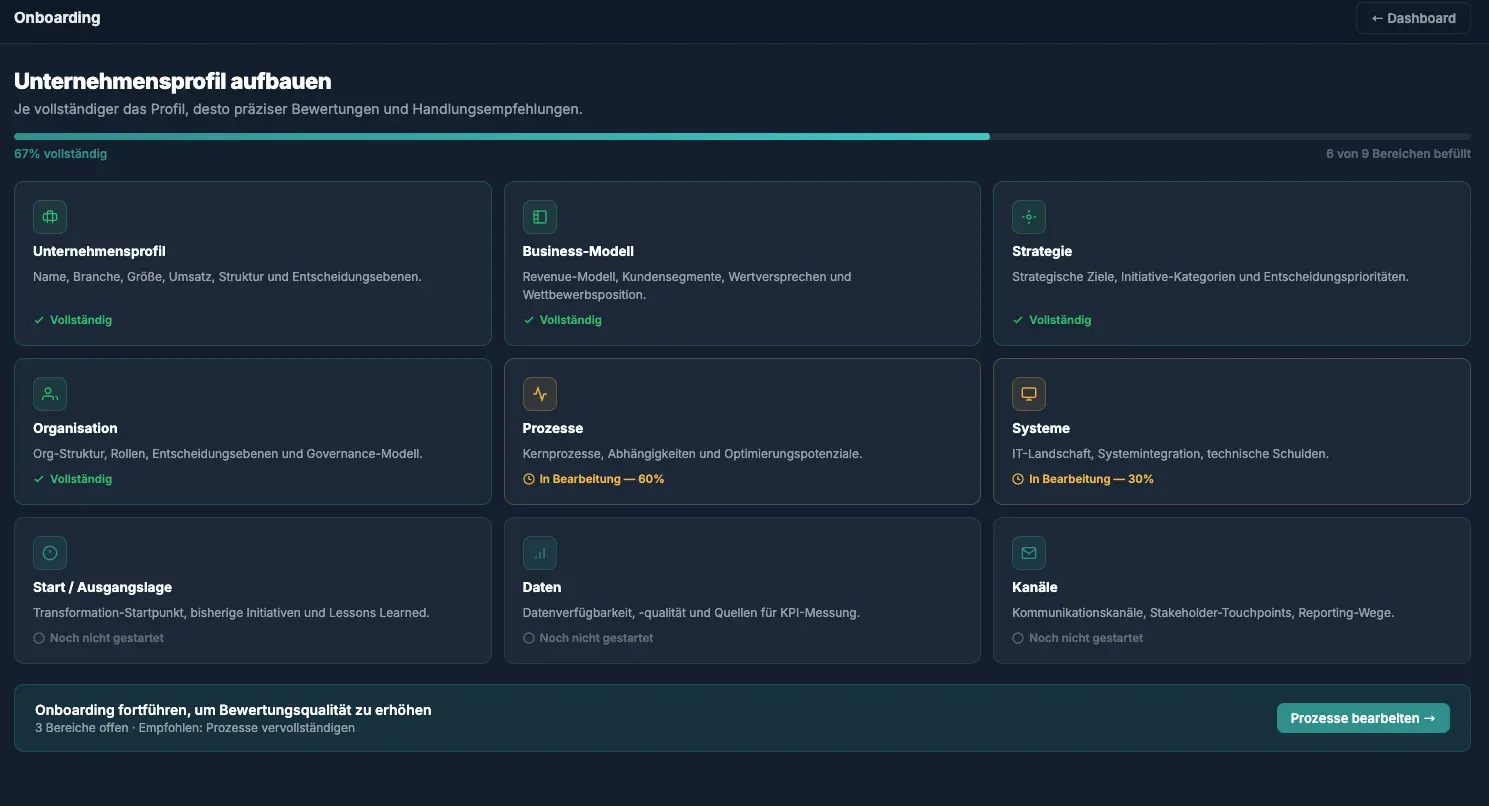
  • Drag documents inPDF, Word or text — no form, no import assistant.
  • AI fills the fieldsIt extracts the important information; every AI-filled value remains marked as such.
  • You refineReview once and only fill the remaining gaps.
Onboarding view: documents are uploaded, AI fills the company profile fields, AI-filled values are marked.
From here on, the system knows your context.Example view with sample data.

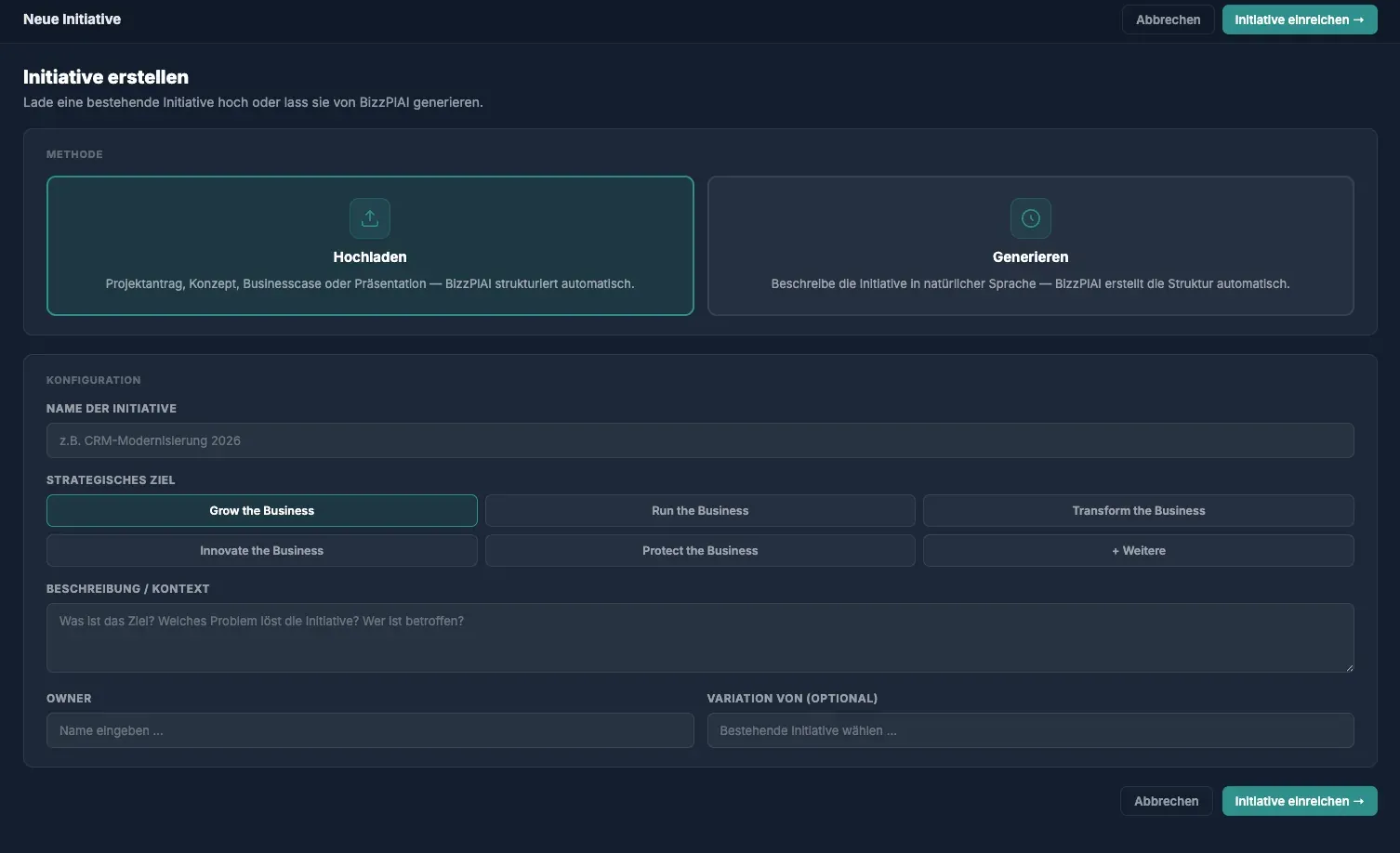
Two paths to an initiative.

  • From a documentProject request, concept, business case — AI extracts and structures automatically.
  • Or from one sentenceDescribe the initiative in natural language; the system builds the structure.
  • Nothing starts from zeroThe company context from onboarding is part of every proposal.
New initiative view with two paths: upload a document or describe the initiative in your own words.
AI proposes and evaluates first — you refine, then the initiative is set.Example view with sample data.

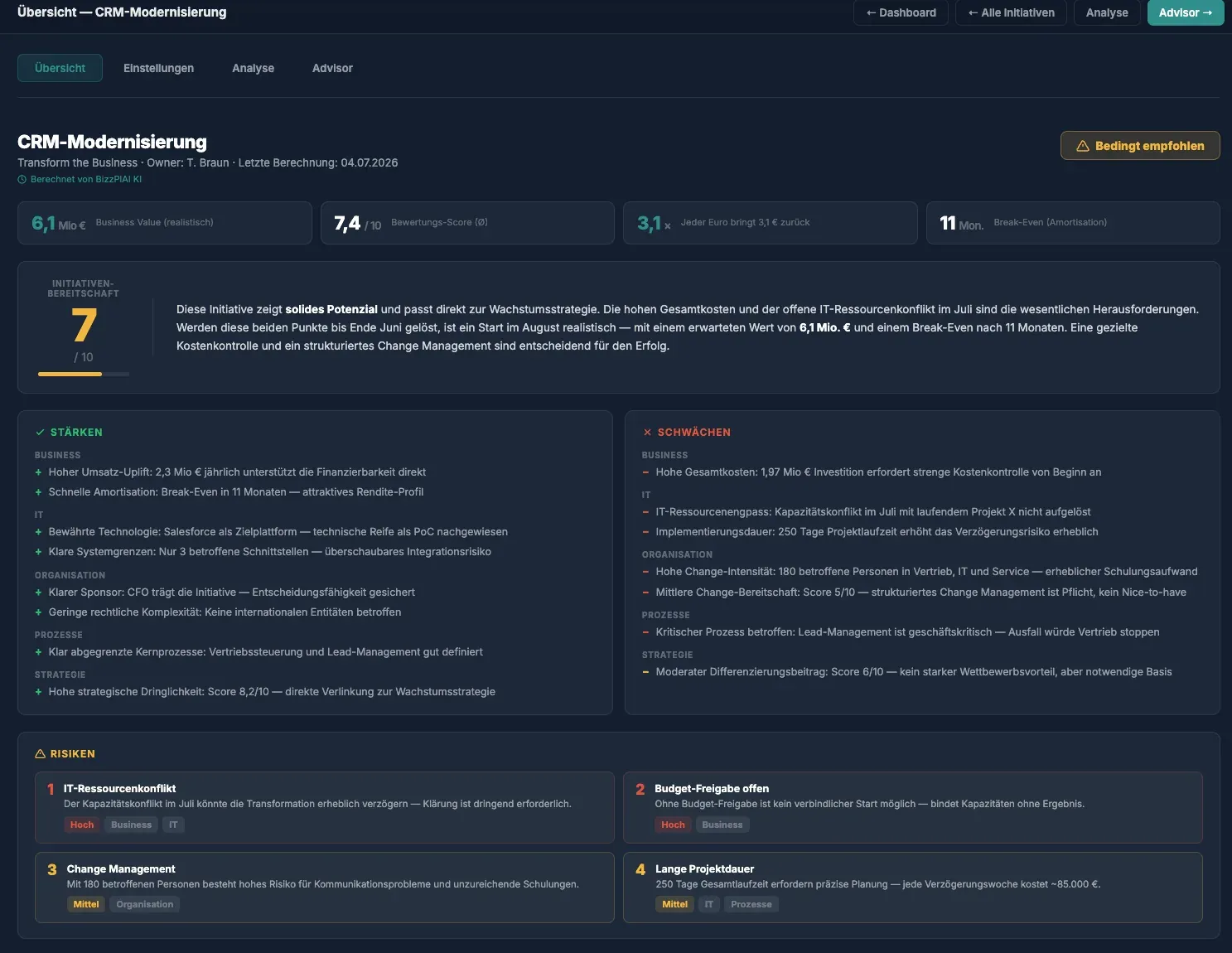
The finished assessment — at a glance.

  • Business value, realistically calculatedNot the best case, but a range with assumptions that are visible.
  • An evaluation score with recommendationRecommended, conditionally recommended or not — with the reasoning next to it.
  • Payback before the first euroWhen the initiative pays for itself — calculated before budget flows.
  • The organization is part of the calculationThe possible value is offset against your organization's capacity for change. The difference sits next to it as an amount, not as a traffic light.
Overview of an initiative with business value, evaluation score, payback period and a recommendation.
Plus strengths, weaknesses and risks — all generated automatically.Example view with sample data.

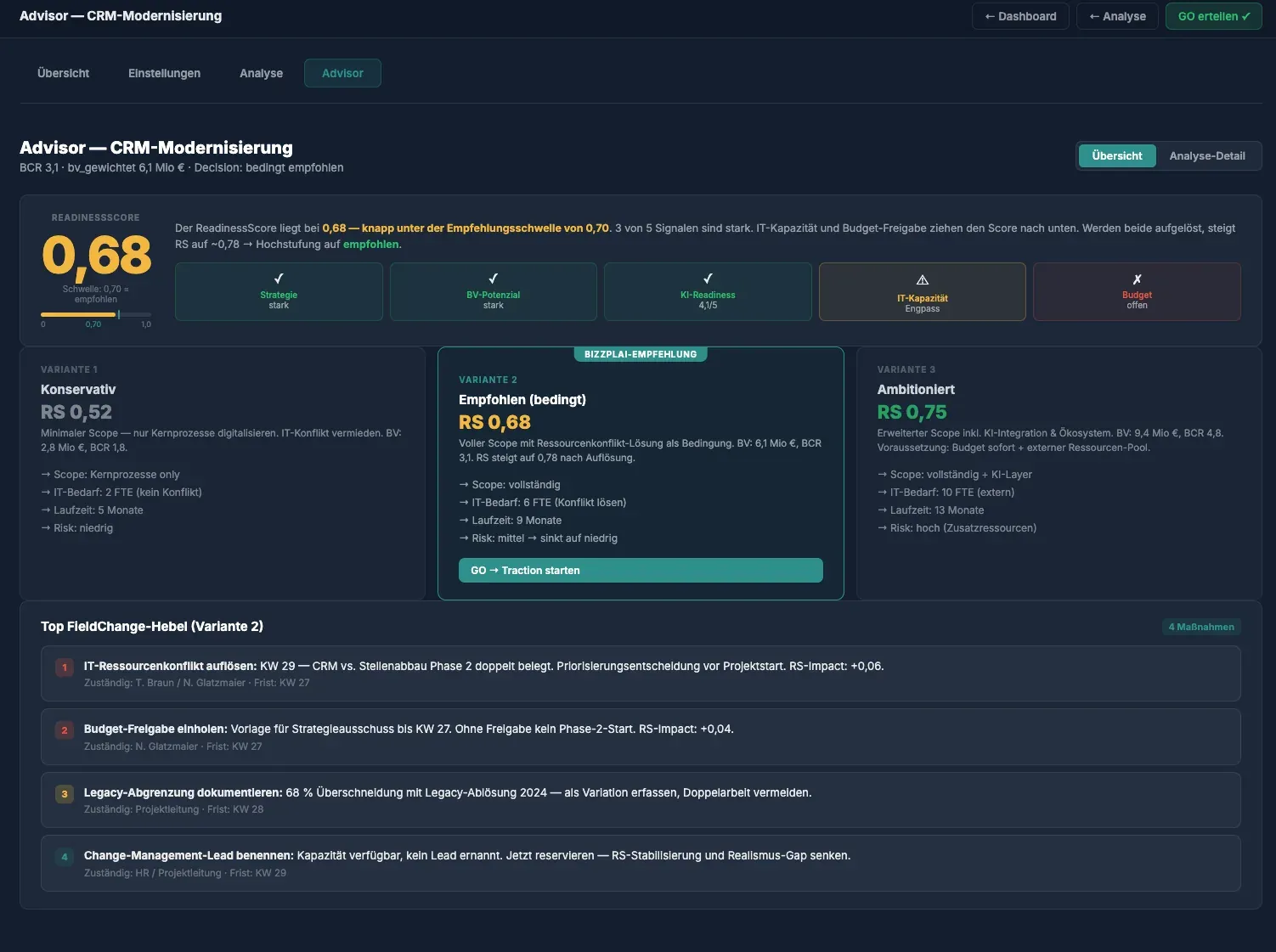
The same initiative — three perspectives.

  • Three variants instead of one truthDepending on risk appetite: own scope, own duration, own risk.
  • A readiness score shows approval maturityFive signals, transparently broken down instead of a grade from nowhere.
  • Concrete levers — then approvalThe system shows what raises the score. If it fits, the initiative moves into execution.
Advisor view with the three variants conservative, recommended and ambitious as well as a readiness score.
Conservative · Recommended · Ambitious — each with its own scope, duration and risk.Example view with sample data.

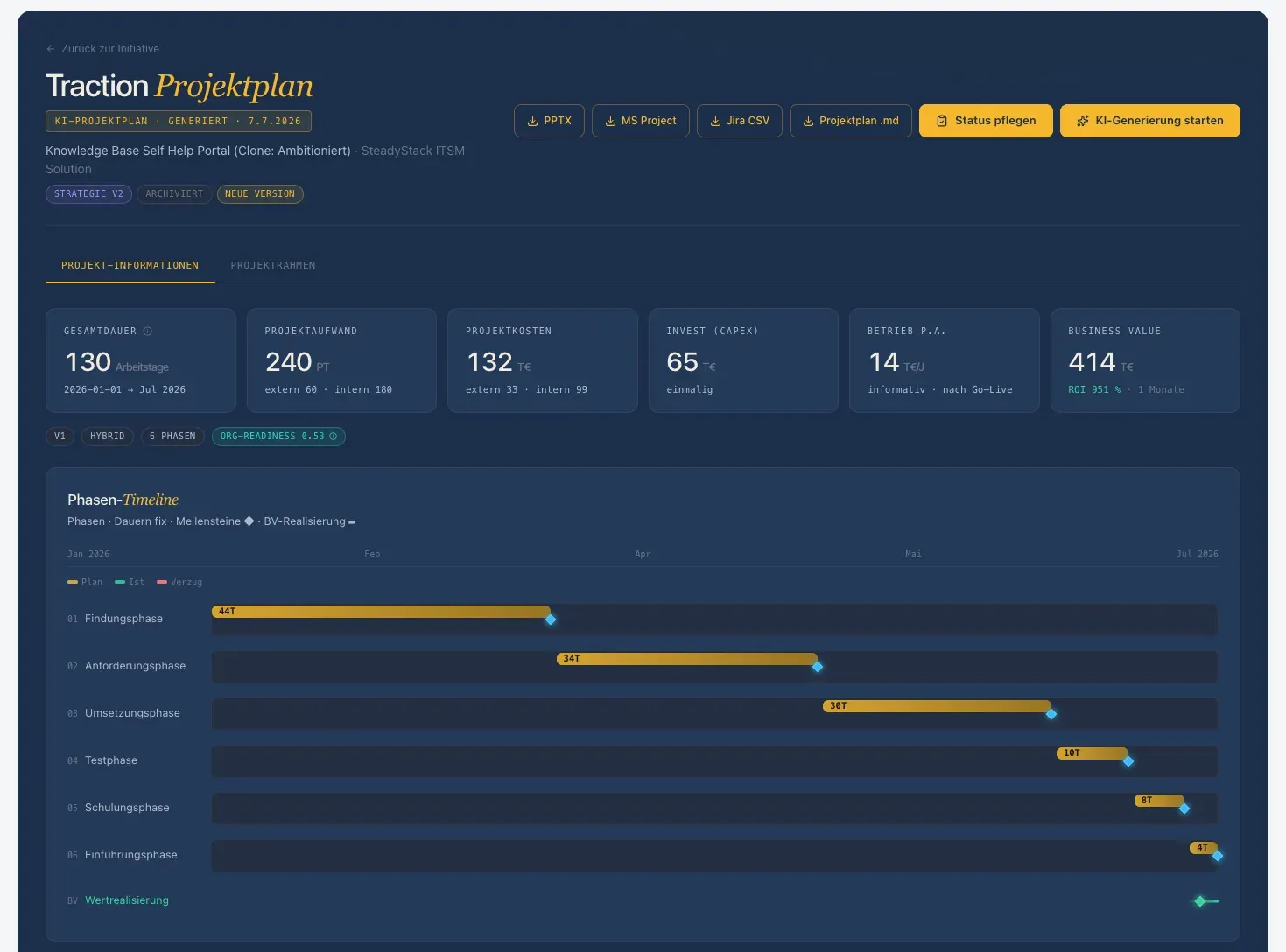
Approval becomes execution.

  • A complete project plan, generatedPhases, milestones and timeline are created automatically from the evaluation.
  • Effort, cost and value per projectSide by side, not spread across three tools.
  • Scope and success criteria per phaseWhat belongs and what does not — captured before arguments begin.
Traction view with automatically generated project plan: phases, milestones, timeline, effort and business value.
Every initiative joins the project list — and flows back into the cockpit.Example view with sample data.

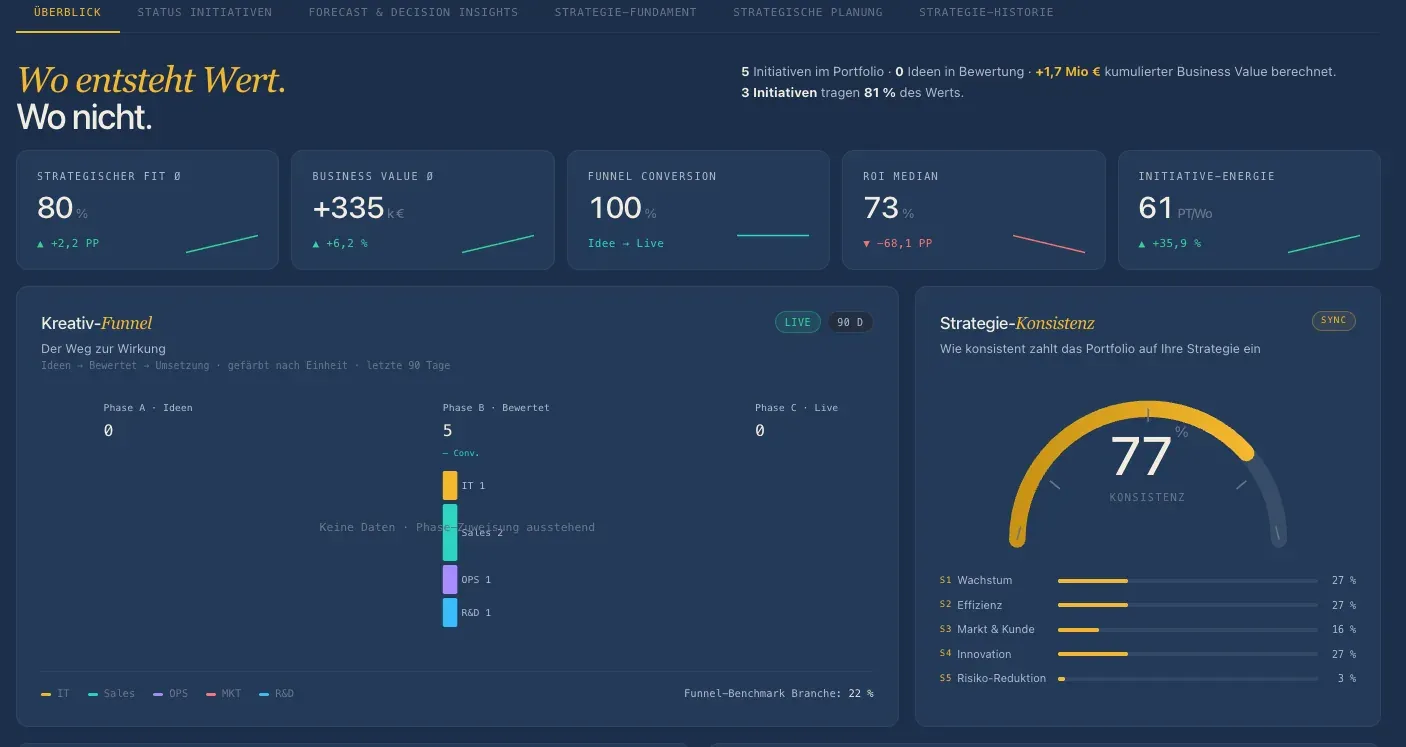
The management overview.

  • Where value emerges — and where it does notThe strategic fit of every initiative at a glance.
  • Cumulative business valueThe accumulated value of the whole portfolio, not individual projects.
  • The funnel: idea -> liveHow initiatives convert from idea to execution — and where they get stuck.
Cockpit overview with KPIs for strategic fit, business value, funnel conversion and strategy consistency.
What is running, what is wobbling, what should end — without requesting a report.Example view with sample data.

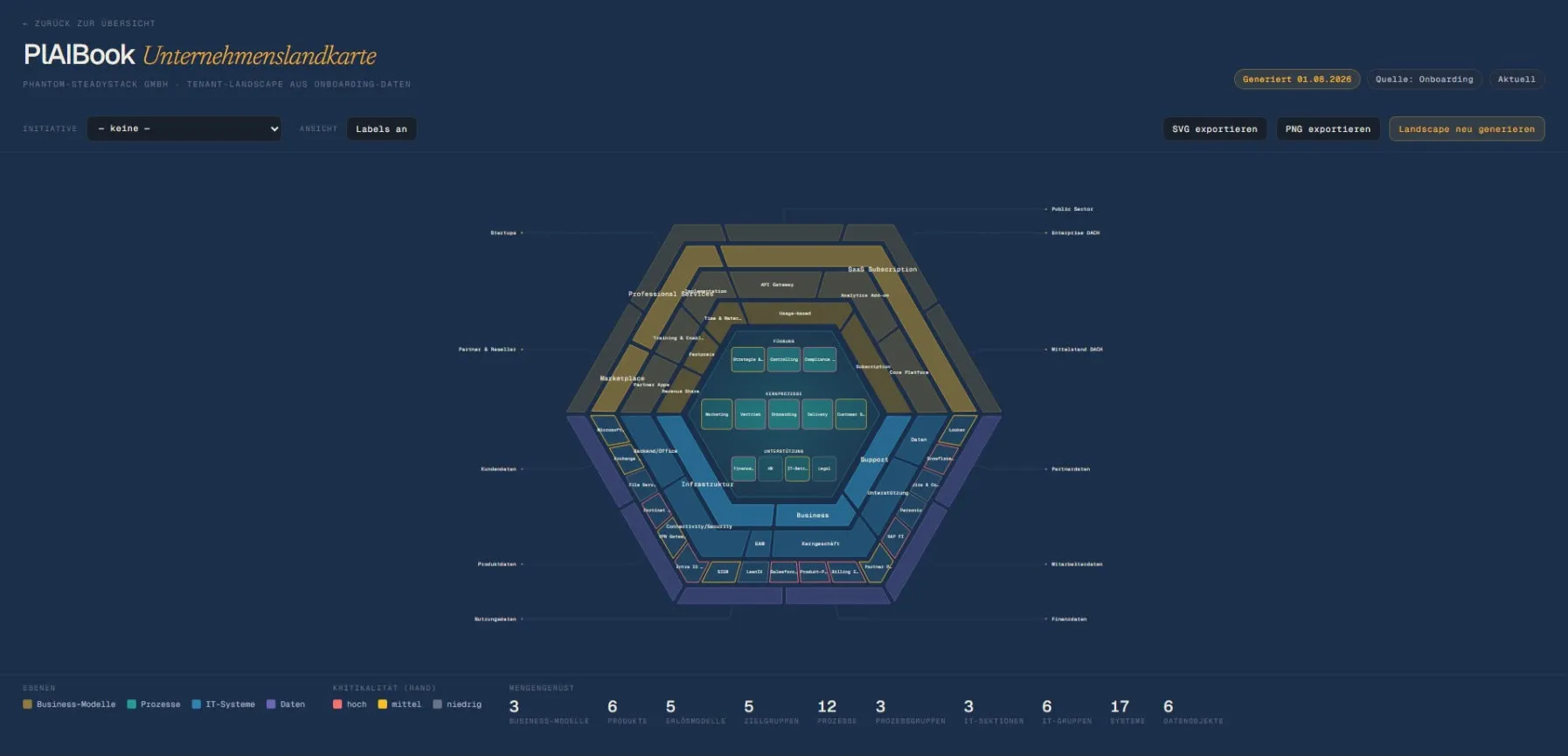
The company map shows where change really has impact.

Prototype
  • The company as a system mapBusiness models, processes, IT systems and data are not shown in isolation, but in relation to each other.
  • Generated from onboarding dataThe map emerges from company context and makes visible which structure BizzPlAI evaluates.
  • Initiatives in their impact spaceInstead of only seeing a project list, it becomes clear where an initiative touches the company.
  • Exportable and currentThe prototype is designed for export and updating — as a working picture for consulting, management and execution.
PLAIBook company map on a dark background with business models, processes, IT systems and data layers.
PLAIBook company map — generated from onboarding data and initiative context.Example view with sample data.

Every metric can be traced back to its formula.

A business case does not convince because it is high, but because it holds. So BizzPlAI calculates in the open — and says so when a figure is missing.

01

Calculated, not estimated

Total cost, net present value and benefit-cost ratio come out of stored formulas. Three evaluation methods work on the same data — if they diverge, you see it.

02

Seven value types, twelve metrics

Every source of return has its own defined question, from cost impact to avoided risk. No catch-all item with an estimate hidden inside it.

03

The AI does not calculate, it checks

The AI assessment runs alongside the calculated result, not in its place. It is a reference line: if it diverges, that is a signal — not a new number.

04

Empty beats invented

If a figure is missing, the field stays empty and the gap shows in the result. BizzPlAI does not insert a plausible value to make the calculation work.

Frequently asked questions about the product

Is BizzPlAI just another project management tool?

No. PM tools track tasks. BizzPlAI evaluates impact: it connects strategy, initiatives, business value and execution — and shows whether the strategy is actually moving forward. This is a steering layer, not a task list.

Does BizzPlAI replace our consulting?

No — quite the opposite. Consulting brings expertise. BizzPlAI keeps steering and knowledge permanently inside the company. Consultants work with BizzPlAI, not against it.

Do we need to be technical to work with it?

No. BizzPlAI is built for decision-makers, not IT teams — plain language instead of jargon fog. Onboarding handles the setup.

Where is our data stored?

On request, exclusively in Germany / the EU, with role-based access and encryption. Your strategic data stays where it belongs.

Where do the numbers in the business case come from?

From stored formulas, not from a language model’s estimate. Total cost, net present value and benefit-cost ratio are calculated; three evaluation methods examine the same data. The AI assessment runs alongside as a reference line — if it diverges, that is a signal, not a new number. If a figure is missing, the field stays empty and the gap shows in the result.

Prefer to click through it yourself?

30 minutes, one real example from your company — instead of a tour through someone else's numbers.